
Imola Circuit: History, Legendary Corners and Great Emotions

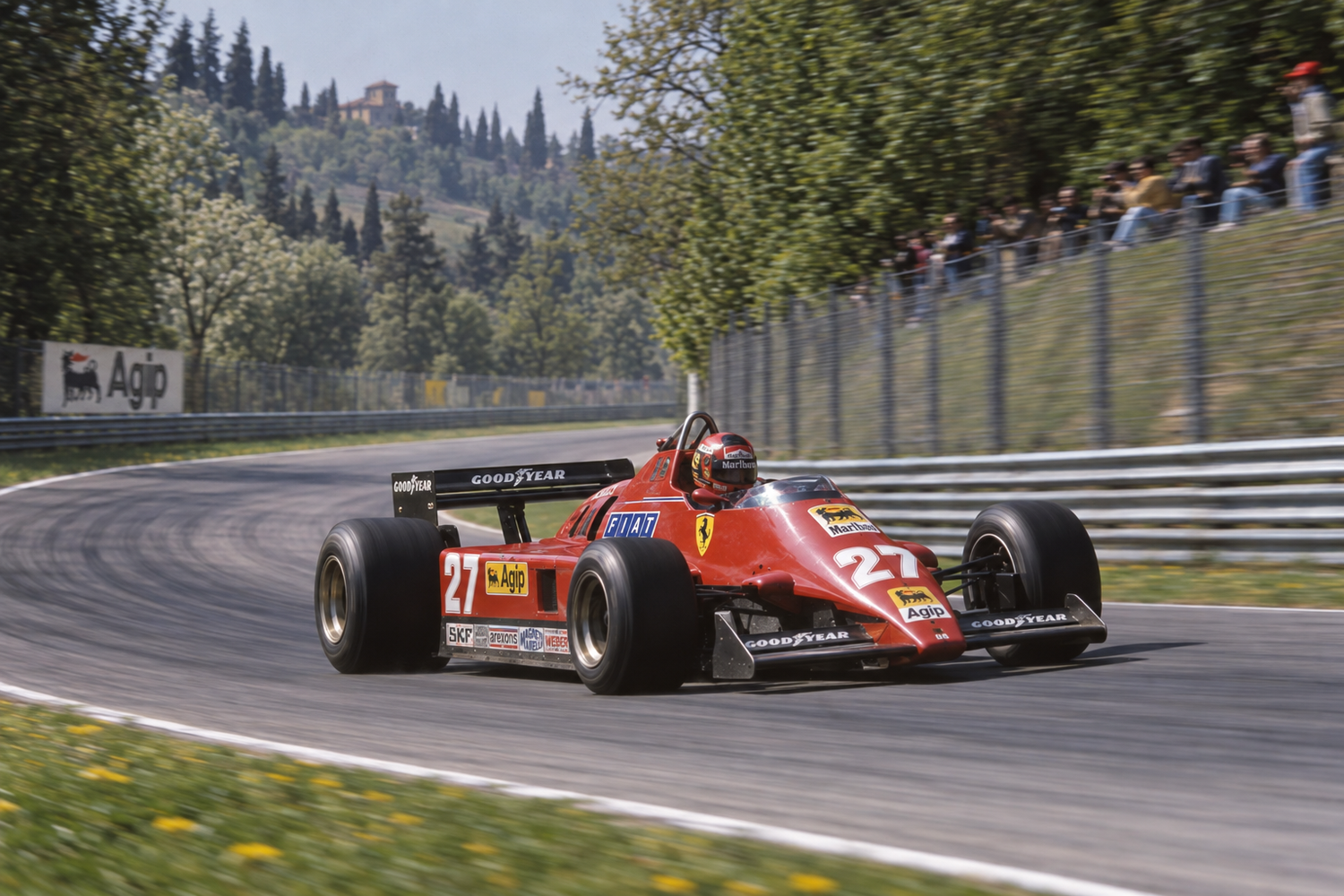
Some circuits are built far from cities, surrounded only by car parks and large grandstands. The Enzo and Dino Ferrari International Circuit in Imola is completely different.
The track follows the hills, crosses the greenery of the Acque Minerali Park and runs close to the houses and the Santerno River. It is part of the city and its history.
Some of the greatest drivers of all time have raced here. Rivalries, unforgettable victories and painful events that changed Formula 1 forever have all taken place at Imola.
A CIRCUIT BORN FROM ROMAGNA’S PASSION FOR MOTORSPORT
The history of the circuit began after the Second World War, when a group of motorsport enthusiasts from Imola imagined a permanent track using country roads located between the Santerno River, the Acque Minerali Park and the first hills.
Construction began in 1950. The track was tested on 19 October 1952 by some of the greatest drivers of the time, including Alberto Ascari, Giuseppe Farina and Luigi Villoresi.
The official opening took place on 25 April 1953 with the CONI Grand Prix, a motorcycle race.
The track was just over five kilometres long and, for several years, some sections continued to be used by ordinary road traffic.
Imola was therefore born as a circuit deeply connected to its surroundings: not a facility designed from scratch, but a racetrack shaped by the landscape.
THE ARRIVAL OF FORMULA 1
Formula 1 came to Imola for the first time on 21 April 1963.
The race was not part of the World Championship and Ferrari, despite being eagerly awaited, did not take part. Jim Clark won the race driving a Lotus.
Another non-championship race, the Dino Ferrari Grand Prix, was held in 1979. However, the date that marked Imola’s true entry into Formula 1 history was 14 September 1980.
That year, the Italian Grand Prix moved away from Monza and was held on the banks of the Santerno River. Nelson Piquet won the race in a Brabham.
In 1981, Monza returned as the home of the Italian Grand Prix, while Imola became the venue for the San Marino Grand Prix. This arrangement allowed Italy to retain two events on the Formula 1 calendar.
The San Marino Grand Prix continued to be held at Imola until 2006.
WHY IT IS CALLED ENZO AND DINO FERRARI
In 1970, the circuit was named after Dino Ferrari, Enzo Ferrari’s son, who died prematurely in 1956.
Enzo Ferrari had supported the development of the circuit from its earliest days and considered Imola particularly useful for testing both drivers and cars.
After the death of Ferrari’s founder in 1988, Enzo’s name was added to that of his son.
Its official name has since been the Enzo and Dino Ferrari International Circuit.
The connection with Ferrari remains extremely strong. Whenever the red cars take to the track, Imola’s hills and grandstands fill with flags and fans from all over the world.
AN OLD-SCHOOL CIRCUIT
The current circuit is 4.909 kilometres long and has 19 corners. It is driven anticlockwise, a relatively unusual feature among international circuits.
Imola is a narrow and technical track, full of climbs and descents. There is an elevation difference of approximately 33 metres between its lowest and highest points.
Drivers must deal with blind corners, sudden changes of direction and sections where the walls remain very close to the track. Mistakes can be costly and overtaking is never easy.
Because of these characteristics, the circuit has also been nicknamed the “little Nürburgring”, after the legendary German racetrack.
IMOLA’S MOST FAMOUS CORNERS
Every corner at Imola has a name, and many preserve an important part of motorsport history.
TAMBURELLO
Tamburello was once a very long, high-speed bend. Today it is a slower chicane, introduced after the tragic 1994 Grand Prix.
Before the changes, it was the scene of several accidents: Nelson Piquet’s crash in 1987, Gerhard Berger’s terrifying Ferrari fire in 1989 and, above all, Ayrton Senna’s fatal accident.
VILLENEUVE
The corner is named after Gilles Villeneuve, who had a spectacular accident here in 1980 but fortunately escaped without serious injury.
In 1994, during Saturday’s qualifying session, Roland Ratzenberger lost his life at this point of the circuit. From 1995 onwards, Villeneuve was also transformed into a chicane to reduce speed.
TOSA
Tosa is one of the circuit’s most famous and recognisable corners.
In 1982, Didier Pironi overtook Gilles Villeneuve during the final stages of the race, breaking what the Canadian driver believed was an internal Ferrari agreement.
In 1989, Tosa became one of the symbolic locations of the rivalry between Ayrton Senna and Alain Prost.
PIRATELLA AND ACQUE MINERALI
After Tosa, the track begins to climb towards Piratella, a fast, difficult and partially blind corner.
The circuit then descends towards Acque Minerali, one of its most spectacular sections. The cars enter a compression, rapidly change direction and then climb again towards Variante Alta.
RIVAZZA
The two Rivazza corners lead back towards the main straight. They are surrounded by a hillside that becomes a sea of spectators and flags during major competitions.
This is one of the best places to appreciate what makes Imola so special: a demanding racetrack surrounded by a natural landscape, with the fans incredibly close to the action.
THE TRAGIC WEEKEND OF 1994
The 1994 San Marino Grand Prix represents the most painful chapter in the circuit’s history.
On Friday, Rubens Barrichello was injured in a serious accident at Variante Bassa.
On Saturday, Roland Ratzenberger died at the Villeneuve corner.
On Sunday, during the race, Ayrton Senna left the track at Tamburello and lost his life.
That weekend shocked the sporting world and led to a major review of safety standards for both Formula 1 cars and circuits.
At Imola, Tamburello and Villeneuve were transformed into chicanes. Other parts of the circuit, including Acque Minerali, Rivazza and Variante Bassa, were also modified.
A monument dedicated to Ayrton Senna now stands in the Acque Minerali Park, close to the place where the accident happened. The statue has become a place of remembrance visited by fans from all over the world.
RACES THAT BECAME LEGENDARY
Imola is not only a place of remembrance. The circuit has also hosted unforgettable sporting battles.
In 1982, the duel between Didier Pironi and Gilles Villeneuve divided Ferrari and deeply marked the final days of the Canadian driver’s life.
In 1983, Riccardo Patrese went off the track at Acque Minerali while leading the race, handing victory to Patrick Tambay and Ferrari.
In 2005, Fernando Alonso managed to resist an extraordinary comeback by Michael Schumacher. After many laps with the two cars running incredibly close together, the Spanish driver won by just two-tenths of a second.
Michael Schumacher is the most successful driver at Imola, with seven victories, six of them achieved with Ferrari.
FORMULA 1 RETURNS TO IMOLA
After the 2006 edition, Imola disappeared from the Formula 1 calendar.
The circuit underwent major renovations. The old pit complex was demolished and the Variante Bassa used by Formula 1 cars was removed, creating a long acceleration section from Rivazza to Tamburello.
Formula 1 returned in 2020, during the season affected by the pandemic.
The race was renamed the Emilia-Romagna Grand Prix, bringing Imola back to the attention of an international audience.
In 2023, the Grand Prix was cancelled because of the devastating floods that affected Emilia-Romagna.
MUCH MORE THAN FORMULA 1
The history of the circuit is also closely connected to motorcycle racing.
Imola has hosted the Motorcycle World Championship, the Superbike World Championship and the famous Imola 200, created by Checco Costa and considered the “Daytona of Europe”.
The circuit has also welcomed the World Endurance Championship, motocross, the Ferrari Challenge and numerous national and international competitions.
Imola has hosted the Road Cycling World Championships, stages of the Giro d’Italia and major concerts.
AC/DC and Guns N’ Roses are among the international artists who have performed here, together with the many bands and musicians who took part in the Heineken Jammin’ Festival.
The circuit is therefore much more than a racetrack: it is one of Romagna’s most important sporting, cultural and musical venues.
VISITING IMOLA AND ITS CIRCUIT
The circuit is worth visiting even when no races are taking place.
A walk through the Acque Minerali Park allows visitors to see several parts of the track up close and reach the monument dedicated to Ayrton Senna.
Imola’s historic centre is also nearby and can easily be explored on the same day.
Before travelling, it is advisable to check the circuit’s official website for the events calendar, guided tours and access information.
FROM FORLÌ TO IMOLA
Forlì is a convenient base for exploring the Motor Valley and attending events at the Enzo and Dino Ferrari International Circuit.
The two cities are located on the same railway line and are also connected by the Via Emilia and the A14 motorway.
When you stay at BB Romagna Mia, you can easily reach Forlì railway station. After a day filled with motorsport, history and excitement, you can return to a spacious, peaceful and fully equipped apartment.
BB Romagna Mia offers:
• two air-conditioned bedrooms;
• accommodation for five guests, plus a cot;
• a fully equipped kitchen;
• a spacious living room;
• free Wi-Fi;
• private parking and free on-street parking;
• a balcony;
• an entire apartment exclusively reserved for guests.
It is a particularly convenient choice for families, groups of friends and motorsport enthusiasts who want to experience the events in Imola while also discovering Forlì and the rest of Romagna.
Discover BB Romagna Mia and book your stay in Forlì.
Tel & whatsapp +39 3311 147147